


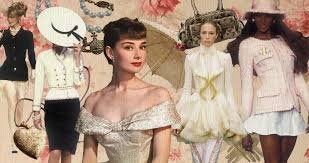
Every decade in twentieth-century fashion produced pieces worth collecting. However, not all decades are equal in what they offer the buyer today – in terms of wearability, cultural resonance, condition availability, and value for money. The strongest material comes from specific creative periods when the industry was producing work that was both technically exceptional and culturally loaded.
This guide breaks down vintage designer clothing for women decade by decade, focusing on the creative periods that produced the most technically accomplished and most collectible work available in the current market – and what to look for within each one.
The 1960s – Geometry, Colour, and Couture Weight
The 1960s was the decade when ready-to-wear became a serious creative category. Yves Saint Laurent’s Mondrian collection of 1965, Courrèges’s Space Age silhouettes, and Pierre Cardin’s geometric experiments all produced pieces that defined the decade visually and have never lost their appeal. These garments were made to couture or near-couture standards even at ready-to-wear prices.
The fabric weights, the lining construction, and the internal finishing all reflect an era when mass production had not yet stripped the quality from high-fashion. The challenge with 1960s pieces is condition – sixty years is a long time for fabric, and the synthetic materials popular in the decade can degrade in ways not always visible until a piece is handled. Wool crepe and structured linen hold up better and represent the best value.
The 1970s – The Decade of Cut
The 1970s produced some of the most technically accomplished ready-to-wear in fashion history. Halston’s bias-cut jersey dresses, Diane von Furstenberg’s wrap dress, Yves Saint Laurent’s Le Smoking suit, and Geoffrey Beene’s column gowns all demonstrate a mastery of cut and drape that has rarely been matched in volume production since. The clothes of this decade were designed to move with the body in a way that later, more structured fashion does not.
Yves Saint Laurent from the mid-1970s through the early 1980s represents one of the strongest buying opportunities in the entire vintage market. His Rive Gauche line produced sophisticated tailoring, folkloric embroidery, and elegant evening pieces at a volume that means genuine examples are still relatively findable. The price has increased significantly in recent years but remains lower than comparable Chanel or Givenchy material from the same period.
Collectors focused on this decade should also look at vintage Missoni – the knitwear in particular. The distinctive zigzag and flame patterns from the 1970s Missoni archive are immediately recognisable, extremely wearable, and have appreciated steadily as appreciation for Italian manufacturing of the period has grown.
The 1980s – Power Dressing and Technical Excellence
The 1980s produced both excess and excellence. The power dressing silhouette – strong shoulders, nipped waist, sharp tailoring – was executed at a very high level by Thierry Mugler, Claude Montana, and Azzedine Alaïa. These are not soft or easy clothes. They make demands of the wearer in the best possible way, and the construction quality is extraordinary.
Azzedine Alaïa’s work from this decade stands apart from almost anything else in vintage fashion. His bodycon pieces from the mid-1980s – the stretch wool bandage dresses, the leather skirts, the pointed-toe boots – show a command of fit and material that has no real parallel. Alaïa made relatively small quantities compared to the larger houses, which keeps supply tight and prices firm.
The 1980s also produced some of the best vintage Chanel for the money. Karl Lagerfeld’s early designs from the mid-1980s through the early 1990s are creative and distinctive without yet carrying the full premium of the later Lagerfeld classics. Tweed suits, chain-handled bags, and logo jersey pieces from this period represent strong value relative to where the same era’s Chanel was priced five years ago.
The 1990s – Minimalism, Then the Opposite
The 1990s aesthetic was a deliberate reaction to the excess of the 1980s. Helmut Lang, Jil Sander, and early Calvin Klein produced clothing that was radical in its restraint – minimal colour palette, precise cut, absence of decoration. These pieces hold up exceptionally well today because their design logic was essentially timeless from the start.
However, the 1990s also produced some of the most culturally loaded maximalism in fashion history. John Galliano’s Dior from 1997 onward, Tom Ford’s Gucci from 1995 onward, and Alexander McQueen’s own label from the early 1990s onward represent a parallel universe of dramatic, concept-driven work that has attracted intense collector attention since the mid-2010s.
The best 1990s pieces have already been repriced to reflect that collector attention. However, the depth of the decade’s output is still broad enough that well-priced examples appear regularly for buyers who are patient and specific about what they are looking for.
The Early 2000s – The Underpriced Decade
The early 2000s is the most underappreciated decade in the current market, and that represents a genuine opportunity. The work produced between 1999 and 2005 at houses like Gucci, Dior, Prada, and Balenciaga under Nicolas Ghesquière is technically sophisticated, culturally specific, and still relatively accessible at price points that will not last much longer.
Nicolas Ghesquière’s Balenciaga from 2001 to 2012 is among the most important fashion of the twenty-first century, and it remains significantly underpriced relative to its quality and cultural standing. Original pieces from his early seasons – the structured nylon jackets, the tailored motorcycle pieces, the sculptural knitwear – are the kind of material that will be the subject of major retrospective attention within a decade.For collectors building a long-term wardrobe from the archive, the early 2000s offers the best ratio of quality to current price across any decade. The window for buying ahead of the repricing is open, but it is not permanent. Foundry Vintage is a focused discovery resource for collectors and wearers seeking the best pieces across all decades – curated from vetted resellers with an editorial eye for what actually matters.