


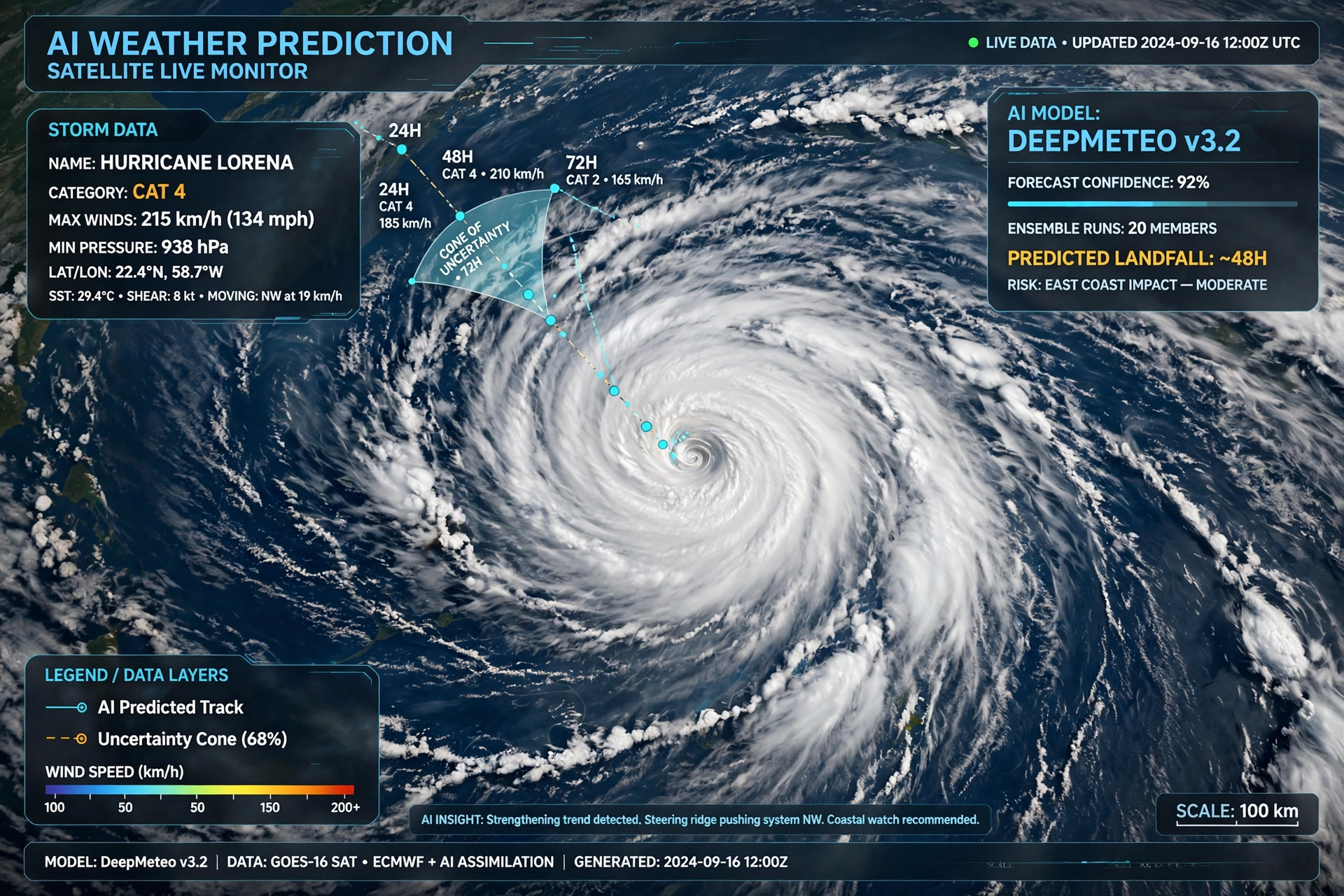
Weather forecasters have always fought the same enemy: time. The further ahead you look, the faster a forecast falls apart. That is why a quiet revolution in artificial intelligence matters so much — in 2026, machine-learning weather models are producing skilful predictions of extreme storms ten days to two weeks out, giving emergency planners something they have rarely had before: a head start.
These systems do not simulate the atmosphere equation by equation like traditional supercomputer models. Instead, they are trained on decades of historical weather data and learn the patterns that precede heatwaves, floods and landfalling storms. The result is a forecast that runs in minutes on modest hardware — and, in test after test, rivals or beats the best physics-based systems.
Why extreme weather is the real prize
Routine forecasts were already good. The breakthrough is in the extremes: the atmospheric river that floods a valley, the heat dome that parks over a city, the hurricane that intensifies overnight. Peer-reviewed studies published through journals such as Nature have shown AI models matching conventional forecasts on ordinary days while flagging dangerous patterns earlier — the difference between a routine warning and a life-saving one.
Agencies are taking notice. The US National Oceanic and Atmospheric Administration and its counterparts in Europe now run AI models alongside traditional ones, comparing outputs in real time. When both approaches agree that a storm is coming, confidence — and the willingness to act early — rises sharply.
What earlier warnings change on the ground
An extra three days of warning transforms emergency management. Hospitals can staff up, utilities can pre-position repair crews, farmers can move livestock and harvest early, and cities can open cooling centres before a heatwave peaks rather than during it. Insurers and logistics firms are building the same signals into their planning, rerouting ships and stocking warehouses ahead of predicted disruption.
There are honest limits. AI models learn from the past, and a warming climate keeps producing weather with no historical precedent. Forecasters stress that the tools are partners, not replacements: human meteorologists still interpret, localise and communicate risk. At News Ross we follow these developments closely, and our recent science coverage explains how the leading models compare.
The bottom line
Extreme weather is getting more expensive and more deadly, which makes every hour of warning more valuable. AI forecasting will not stop a storm — but by reliably seeing it earlier, it gives people the one resource disaster planning cannot manufacture: time.