


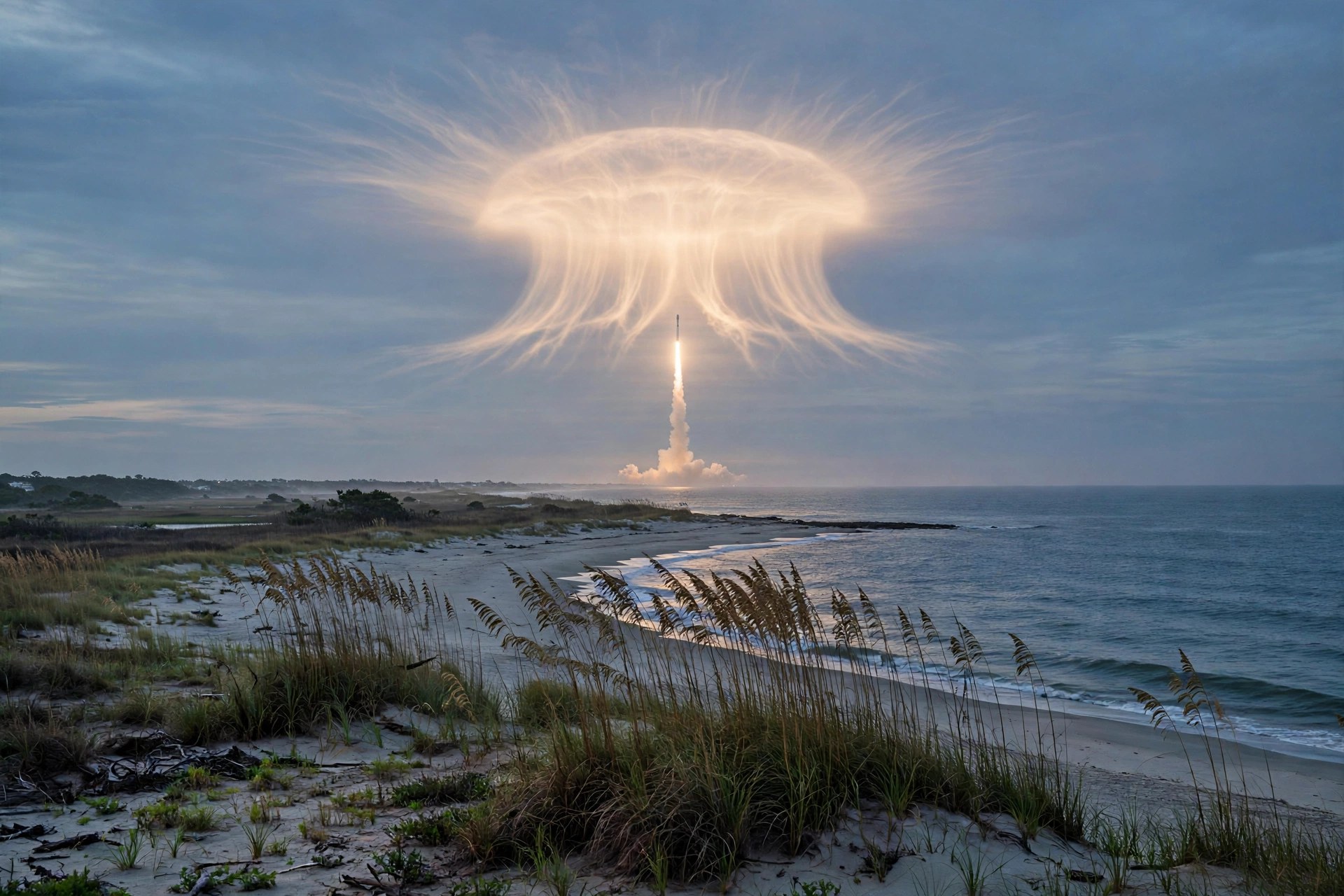
Early risers along the US East Coast were treated to an otherworldly sight this week when a SpaceX rocket launch painted a glowing, jellyfish-shaped cloud across the dawn sky. Photographs shared from beaches, backyards and city rooftops showed a bright teardrop of light with long, translucent tendrils drifting behind it, hanging in the twilight long after the rocket itself had vanished from view. The spectacle, reported by The Guardian, quickly became one of the most talked-about sky events of the season.
What Is a Jellyfish Cloud?
Despite the nickname, a jellyfish cloud has nothing to do with weather. It is the exhaust plume of a rocket, lit up in a very particular way. When a launch takes place shortly before sunrise or just after sunset, the ground below is still in darkness while the upper atmosphere, tens of kilometres above the surface, is already bathed in sunlight. As the rocket climbs, its exhaust gases expand dramatically in the thin air, forming a wide, billowing cloud. Sunlight striking that plume from below the horizon makes it glow against the dark sky, producing the rounded “bell” and trailing “tentacles” that give the phenomenon its name.
The effect is most dramatic during what photographers call the twilight window, roughly half an hour before sunrise or after sunset. Launches outside that window still produce plumes, but in full daylight or full darkness they are far less visible. That is why the same rocket, launched a few hours earlier or later, would have passed almost unnoticed by most people on the ground.
Why This Launch Was So Visible
Several factors combined to make this display especially striking. The launch trajectory carried the rocket along the coast rather than straight out to sea, so the plume stayed in view for longer and could be seen from several states. Clear, dry air along much of the coastline meant there was little ordinary cloud to compete with the glowing exhaust. And because the launch happened in the pre-dawn twilight window, the contrast between the dark landscape and the sunlit plume was at its maximum.
Residents described the cloud changing shape over several minutes, spreading out and fading from brilliant white to soft pastel shades of pink and blue as the exhaust dispersed. Some mistook it for a comet, a meteor or even something stranger, and local newsrooms fielded the usual flurry of puzzled calls that follow a good twilight launch.
A Familiar Sight for the Space Coast
For communities near Florida’s Space Coast, jellyfish clouds have become a semi-regular feature of the modern launch era. The pace of launches has increased sharply in recent years, driven largely by satellite deployment missions listed on SpaceX’s official launch schedule, and each dawn or dusk liftoff carries the potential for another display. What made this one unusual was how far the visibility extended, with clear sightings reported well beyond the usual viewing areas around the launch site.
The phenomenon also has a scientific side. Researchers who study the upper atmosphere watch rocket plumes to understand how exhaust gases spread and interact with the thin layers of air far above the weather. That research overlaps with the fast-moving field of atmospheric prediction, where, as we recently explored, AI weather models are now predicting extreme storms weeks earlier than traditional methods allowed.
How to Catch the Next One
Skywatchers hoping to see a jellyfish cloud for themselves should look for launches scheduled in the twilight window, pick a spot with a clear view towards the launch site, and arrive early. The display typically begins a minute or two after liftoff, once the rocket has climbed high enough for its plume to catch the sunlight, and it can last for five to ten minutes as the exhaust slowly expands and fades. A phone camera on a steady surface is usually enough to capture it, since the plume is bright and large.
With launch cadence still rising, this week’s glowing jellyfish is unlikely to be the last. For millions of people who looked up at the right moment, it was a brief, beautiful reminder that some of the most spectacular sights in the sky are now made by rockets heading to orbit.